Table of contents (13 sections)
Panda Roommates: The Rich Biodiversity of Bamboo Forest Ecosystems
Key Fact: Walk through a panda’s bamboo forest and you enter one of the most biodiverse temperate ecosystems on Earth — part of the Mountains of Southwest China biodiversity hotspot, one of only 34 global biodiversity hotspots. The forest hosts golden snub-nosed monkeys with startling blue faces, massive shaggy takin that look like mythological beasts, red pandas dozing in high bamboo branches, clouded leopards (vanishingly rare), bamboo rats tunneling through the root zone, and over 10,000 plant species. The question this article asks is not why protect pandas — that is covered in our article on the umbrella species effect. The question is how do all these species share the same forest without competing each other to extinction?
Key Takeaways
-
The bamboo forest is a vertically layered community — canopy, mid-story, shrub, and forest floor each host distinct species that rarely interact.
-
Resource partitioning prevents competition — pandas, red pandas, bamboo rats, takin, and golden monkeys all eat bamboo or bamboo-associated plants, but they target different parts, at different heights, at different times.
-
Camera traps have revealed a community far richer than anyone expected — a single reserve can host 80+ mammal species and 200+ bird species, all coexisting in the panda’s forest.
Dawn in a Shared Forest
The bamboo forest at dawn is not silent. The first sound is the chatter of golden snub-nosed monkeys high in the fir canopy — a troop of 30 moving through the branches, their golden-orange fur catching the first light, their blue faces startling against the green. Below them, a takin — massive, shaggy, its curved horns sweeping back from a broad head — moves slowly through the bamboo, its heavy body parting the stalks like a ship through water. A golden pheasant scratches in the leaf litter. A red panda, the giant panda’s smaller namesake, curls on a high bamboo branch, its rusty fur and striped tail making it almost invisible against the autumn leaves.
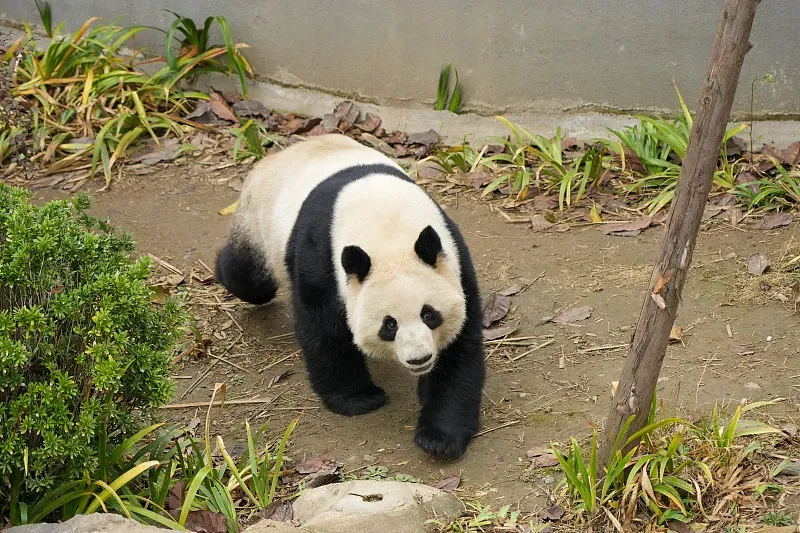
And somewhere in the thick bamboo, unseen, a giant panda chews methodically, indifferent to all of them.
This is the panda’s forest — not a monoculture of bamboo stalks but a complex, layered ecosystem where dozens of vertebrate species and thousands of plants and insects coexist across multiple forest strata. The question is: how?
What Does Sympatric Mean?
Sympatric species are species that live in the same geographic area and potentially encounter each other. The term comes from the Greek syn (together) and patris (fatherland) — literally, species that share the same homeland.
In the panda’s forest, sympatric coexistence is not a mystery — it is the outcome of millions of years of evolution that have pushed each species into its own ecological niche. The forest does not look like a competition arena. It looks like an apartment building where every resident has a different floor.
Vertical Forest Architecture
The single most important mechanism of coexistence in the panda’s forest is vertical stratification — different species occupy different heights of the same forest.
| Forest Layer | Height Above Ground | Primary Plant Community | Representative Vertebrate Species | Primary Activity |
|---|---|---|---|---|
| Canopy | 20-40 m | Fir, spruce, oak, rhododendron | Golden snub-nosed monkey, Sichuan jay | Foraging on leaves, fruit, lichens |
| Mid-story | 5-20 m | Small trees, large shrubs, climbing bamboo | Red panda, tufted deer (browsing), Asiatic black bear (climbing) | Resting, nesting, fruit foraging |
| Shrub layer | 1-5 m | Dense bamboo (Bashania, Fargesia), understory shrubs | Golden pheasant, Temminck’s tragopan, bamboo partridge | Ground nesting, insect foraging |
| Forest floor | 0-1 m | Bamboo litter, moss, herbaceous plants | Giant panda, takin, tufted deer, bamboo rat, leopard cat | Primary feeding, movement, scent-marking |
| Underground | -0.5 to 0 m | Bamboo rhizome network | Bamboo rat, soil invertebrates, fungi | Root foraging, tunneling, decomposition |
The giant panda and the golden snub-nosed monkey share the same forest but rarely see each other. The panda walks; the monkey leaps. The panda eats on the ground; the monkey feeds in the canopy. They are sympatric but ecologically separated by 20 vertical meters.
Bamboo Specialists: Three Species, One Plant
Three mammal species in the panda’s forest depend primarily on bamboo, each targeting a different plant part at a different height.
| Species | Bamboo Part Consumed | Feeding Height | Feeding Time | Daily Consumption | Digestion Strategy |
|---|---|---|---|---|---|
| Giant Panda | Stalks, shoots, leaves | Ground (0-2 m) | 10-16 hours/day | 12-38 kg | Carnivore gut with cellulose-fermenting microbiome |
| Red Panda | Leaves (primarily), shoots | Trees (2-10 m) | 8-12 hours/day | 2-4 kg | Carnivore gut with simple microbiome, low efficiency |
| Bamboo Rat | Roots, rhizomes, lower stalks | Underground (to -0.5 m), ground | Nocturnal | 0.5-1 kg | Specialized rodent gut with high-fiber adaptation |
The three species illustrate the principle of niche partitioning perfectly. The giant panda is a bulk feeder, consuming enormous quantities of bamboo stalks and processing them through a specialized microbiome evolved in a carnivore gut. The red panda is a selective browser, targeting the most nutritious bamboo leaves in the tree layer. The bamboo rat is a root and rhizome specialist, accessing the underground portion of the bamboo plant that neither bear can reach. They are all bamboo specialists. They are not competitors.
Resource Partitioning: How They Avoid Competition
| Resource Dimension | Giant Panda | Takin | Golden Monkey | Red Panda | Tufted Deer |
|---|---|---|---|---|---|
| Primary food | Bamboo (99% of diet) | Bamboo + herbs + shrubs | Leaves, fruit, lichens | Bamboo leaves (90%+) | Understory shrubs, herbs |
| Feeding height | Ground (0-2 m) | Ground (0-1.5 m) | Canopy (15-35 m) | Trees (2-10 m) | Ground (0-1.5 m) |
| Activity pattern | Diurnal (dawn-dusk) | Diurnal | Diurnal | Crepuscular (dawn/dusk) | Crepuscular/nocturnal |
| Social structure | Solitary | Herds of 10-30 | Troops of 20-60 | Solitary | Small groups |
| Home range | 4-30 km² | 10-50 km² (herd) | 10-40 km² (troop) | 2-10 km² | 1-5 km² |
The takin is the species that overlaps most with pandas — both eat bamboo on the ground. But takin are less specialized: they consume a broader range of plants and migrate seasonally to higher elevations where bamboo is less dominant. They also move in herds of 10-30, which pandas would never tolerate. The takin’s herd living is possible because takin are not obligate bamboo specialists — they eat enough other plants to sustain group living.
Camera Trap Discoveries
Before camera traps became standard equipment in panda reserves, our understanding of the panda’s forest community was based on visual surveys, track identification, and limited observation. Camera traps have revolutionized that understanding.
A 12-month camera trap survey in a single sector of the Minshan range (approximately 50 km²) recorded:
- 27 mammal species (9 more than had been documented by ground surveys)
- 43 bird species (18 more than expected)
- 3,742 independent detection events (an animal passing in front of a camera)
- 14 species of conservation concern (IUCN vulnerable or higher)
The survey revealed several species that had not been confirmed in that sector before, including the elusive clouded leopard (3 detection events over 12 months), the yellow-throated marten, and the Chinese mountain cat. It also documented behavioral patterns — a leopard cat hunting at midday, a takin herd moving through the same bamboo patch where a panda had fed hours earlier — that would never have been observed by human researchers.
Camera trap data has fundamentally changed the question researchers ask about the panda’s forest. The old question was “what lives here?” The new question is “how do they all coexist? “
Predator Dynamics
The panda’s forest contains a predator community that, while diminished from its historical composition, remains ecologically functional.
Clouded leopard. The largest predator in the ecosystem, capable of taking prey up to panda cub size. Once widespread across panda habitat, now reduced to a few remnant populations. Camera trap detection rates suggest fewer than 50 clouded leopards may remain within the Giant Panda National Park. Their decline has removed the primary predation pressure on pandas except for cubs.
Asiatic black bear. Omnivorous and adaptable. Black bears and pandas share the forest but occupy different dietary niches — black bears eat fruit, insects, and occasional small animals. Competition between the two bear species is minimal. Black bears may occasionally attack panda cubs or compete for den sites, but documented interactions are rare.
Yellow-throated marten. A large, agile mustelid that hunts birds, small mammals, and occasionally young red pandas. Camera traps have documented martens moving through the bamboo understory, filling the mesopredator niche below the clouded leopard.
Leopard cat. The smallest felid in the ecosystem, hunting rodents and birds. Its presence is an indicator of healthy small-mammal populations in the bamboo forest.
Biodiversity Across Mountain Ranges
The species community varies across the six mountain ranges that host wild pandas, reflecting differences in latitude, elevation range, and habitat quality.
| Mountain Range | Estimated Mammal Species | Estimated Bird Species | Endemic Plant Species | Panda Population | Distinguishing Feature |
|---|---|---|---|---|---|
| Minshan | 120-140 | 300-350 | 200+ | ~600 | Largest area, highest bamboo productivity |
| Qionglai | 100-120 | 250-300 | 150+ | ~350 | High golden monkey density |
| Qinling | 80-95 | 200-250 | 100+ | ~280 | Only range with A. m. qinlingensis subspecies |
| Liangshan | 70-90 | 180-220 | 80+ | ~150 | Highest amphibian diversity |
| Daxiangling | 60-80 | 150-200 | 60+ | ~80 | Most fragmented, highest conservation urgency |
| Xiaoxiangling | 50-70 | 120-180 | 50+ | ~50 | Smallest area, most vulnerable community |
Invasive Species and Future Threats
The bamboo forest ecosystem, while remarkably intact compared to most temperate habitats, faces emerging threats from invasive species and environmental change.
Invasive plants. Several non-native plant species have been documented along roads and near settlements within the Giant Panda National Park. Himalayan balsam, which displaces native understory plants, is the most concerning. The expanding network of park roads and tourism trails creates invasion corridors that require active management.
Climate-driven range shifts. As temperatures rise, the elevation zones that define the bamboo forest community are shifting upward. Species that currently occupy different forest strata are being compressed into narrower elevation bands. The vertical stratification that enables coexistence may be disrupted if the canopy and understory species shift at different rates.
Bamboo flowering. The synchronized mass flowering of dominant bamboo species, described in our article on the 1980s bamboo flowering crisis, affects not just pandas but every species that depends on bamboo — red pandas, bamboo rats, and the insects that feed on bamboo leaves and shoots. A major flowering event represents a temporary but severe food shortage for the entire bamboo-dependent community.
Building a Panda Community Web
The relationships in the bamboo forest form a food web that can be summarized in three layers:
Primary producers. Bamboo (30+ species), canopy trees (fir, spruce, oak, birch), understory shrubs, mosses, lichens. Together, they convert sunlight into the biomass that supports the entire community.
Primary consumers. Giant pandas, red pandas, bamboo rats, takin, tufted deer, golden snub-nosed monkeys (partially), golden pheasants, bamboo partridges, thousands of insect species. Each targets different plant parts, at different heights, at different times.
Secondary and tertiary consumers. Clouded leopards (top predator), Asiatic black bears (omnivore), yellow-throated martens (mesopredator), leopard cats (small predator), eagles, owls, snakes. Together, they regulate the primary consumer populations and maintain ecosystem balance.
Decomposers. Fungi, bacteria, soil invertebrates, carrion feeders. They break down dead plant and animal material, returning nutrients to the soil that supports the next generation of bamboo.
The food web is not a simple chain — it is a complex, interconnected network where each species plays a role that affects multiple others. The panda, despite being the most famous species, is not the most important in this web. The bamboo is. Remove the bamboo, and the entire community collapses — pandas, red pandas, bamboo rats, and all.
Frequently Asked Questions
Do pandas and red pandas ever fight?
Extremely rarely — they occupy different spaces (ground vs. trees) and have no reason to conflict. When they encounter each other, which is uncommon, they typically ignore each other entirely. The two species’ evolutionary relationship is explored in our comparison of red pandas and giant pandas.
What would happen to the ecosystem if pandas disappeared?
The bamboo forest would persist, and most species would survive. The panda is not a keystone species in the strict ecological sense — the ecosystem does not depend on it. However, the loss of the panda would almost certainly mean reduced protection for the forest itself. The panda’s importance is as a conservation flagship, not as an ecosystem engineer. This distinction is explained in detail in our article on the umbrella species effect.
Are any of the panda’s forest neighbors also endangered?
Yes. The golden snub-nosed monkey (Rhinopithecus roxellana) is endangered. The red panda (Ailurus fulgens) is endangered. The clouded leopard (Neofelis nebulosa) is vulnerable. Several bird species — including the Chinese monal (Lophophorus lhuysii) — are near-threatened or vulnerable. The panda’s forest is a refuge for multiple threatened species, which is another reason its protection matters.
How do scientists identify individual animals in camera trap photos?
For species with distinctive markings — golden monkeys (facial patterns), clouded leopards (spot patterns), and some birds (plumage variations) — individuals can be identified visually. For pandas, which all look similar to human eyes, individual identification requires DNA analysis of collected fecal samples or, more recently, AI-based fur pattern recognition as described in our article on AI facial recognition for pandas.
Your Turn
At dusk, the golden monkeys settle into their sleeping clusters, the takin retreat to higher slopes, the red panda curls tighter on its branch. The panda, having eaten for twelve hours, settles against a tree trunk and closes its eyes. The forest does not sleep — it shifts from the diurnal community to the nocturnal, from the birds and monkeys to the owls and flying squirrels. The panda is one thread in this tapestry. Read our article on why pandas live alone to understand how this solitary bear navigates a forest full of neighbors, and our analysis of the umbrella species effect to see why protecting this community matters.

Dr. Sarah Hartwell
Habitat & Ecology Editor
Conservation biologist specializing in habitat assessment, climate change impacts, GIS-based conservation planning, and bamboo corridor restoration. Reviews all habitat and ecology content.
View full profile →Tags in this article
Questions readers often ask
What animals live alongside wild pandas?
The panda's bamboo forest hosts an extraordinary community: golden snub-nosed monkeys in the canopy, takin (large goat-antelopes) on the forest floor, red pandas in the trees, clouded leopards (rare), tufted deer, Asiatic black bears, golden pheasants, Temminck's tragopans, bamboo rats, and countless smaller species. The panda is the most famous resident but far from the only one.
How do so many species coexist without competing for the same food?
Through a process called resource partitioning — different species use different parts of the same forest. Pandas eat bamboo on the ground; red pandas eat bamboo in the trees. Golden monkeys eat leaves and fruit in the canopy. Takin eat bamboo but also consume a wider variety of plants than pandas. Tufted deer browse on understory shrubs rather than bamboo. By dividing the forest vertically and dietarily, these species avoid direct competition.
Do pandas and red pandas compete for bamboo?
Very little. The two species have partitioned the bamboo niche vertically: giant pandas feed on the ground, red pandas feed in trees. They also target different bamboo parts — pandas prefer stalks and shoots, red pandas prefer leaves. Both evolved the pseudo-thumb for bamboo gripping, but they did so independently — one of the most striking examples of convergent evolution in mammals.
Are there predators that hunt pandas?
Adult pandas have few natural predators due to their size. Clouded leopards and Asiatic black bears may occasionally attack cubs or weakened adults. The primary predator threat to pandas in the past was the clouded leopard, now vanishingly rare in panda habitat. Today, the greatest danger to wild pandas comes not from predators but from habitat fragmentation, bamboo flowering, and human activity.
How has camera trap technology changed our understanding of the panda's ecosystem?
Camera traps have revealed a far richer community than earlier survey methods suggested. A single camera trap station in the Minshan range recorded 27 mammal and 43 bird species over 12 months. The data has documented rare species like the clouded leopard, has provided population estimates for takin and golden monkeys, and has revealed behavioral patterns — including nocturnal activity of species previously assumed to be diurnal — that were unknown before camera trap networks were deployed.
Which mountain range has the highest sympatric diversity?
The Minshan range, with the largest area of intact panda habitat and the highest bamboo productivity, supports the greatest overall species diversity. The Qionglai range is second. The Qinling range, while hosting the highest mammal density per square kilometer, has lower overall species richness due to its more northerly latitude and smaller area of intact forest.
What invasive species threaten the bamboo forest ecosystem?
Several non-native plants have been documented in panda habitat, primarily along roads and near human settlements within the Giant Panda National Park. These include the Himalayan balsam (Impatiens glandulifera) and a few agricultural weeds. To date, invasive species have not reached problematic levels in intact panda forest, but the expanding road network and tourism infrastructure create invasion corridors that require active management.
How does the bamboo forest food web work?
Bamboo is the foundation. Primary consumers include pandas, red pandas, bamboo rats, and insects that feed directly on bamboo. Secondary consumers include leopard cats, yellow-throated martens, and birds of prey that feed on bamboo rats and insects. Top predators include the clouded leopard and Asiatic black bear. Decomposers — fungi, insects, microorganisms — recycle bamboo litter into soil nutrients, completing the cycle.