Table of contents (6 sections)
Red Panda vs Giant Panda: Are We Actually Related? 🐼🦊
❓ The big question: Red pandas and giant pandas — they share a name and they both love bamboo. So are they family? Cousins? Distant relatives?
The answer is one of the biggest SURPRISES in animal science: Red pandas and giant pandas are NOT related! They are about as closely related as a cat is to a dog. Their shared love of bamboo is one of nature’s most amazing coincidences!
Key Takeaways
-
🐻 Giant pandas are BEARS. Their closest relatives are spectacled bears in South America.
-
🦝 Red pandas are WEASEL-COUSINS. They’re more closely related to raccoons and skunks than to giant pandas!
-
🌿 Bamboo brought them together. Two unrelated animals evolved the same diet, the same gripping wrist bone, and the same forest home — completely independently!
The Family Tree Surprise 🌳
Let me show you the ACTUAL family trees:
Giant Panda’s family:
BEAR FAMILY (Ursidae)
├── Giant Panda 🐼 (earliest branch, split off 19 million years ago)
├── Spectacled Bear 👓 (closest living relative)
├── Sun Bear ☀️
├── Sloth Bear 🦥
├── Black Bear 🐻
├── Brown Bear 🐻
└── Polar Bear ❄️
Red Panda’s family:
WEASEL SUPERFAMILY (Musteloidea)
├── Red Panda 🦊 (in its own special family, Ailuridae)
├── Raccoon 🦝
├── Weasel 🦨
└── Skunk 🦨
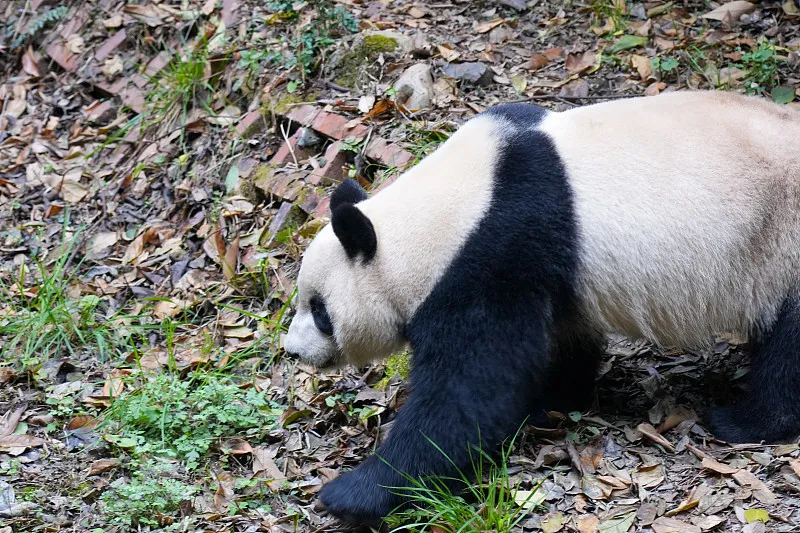
See? Giant pandas hang out with grizzlies and polar bears. Red pandas hang out with raccoons and skunks. They are on COMPLETELY different branches of the animal family tree!
How Did They End Up So Similar? 🤔
This is the coolest part of the story. Red pandas and giant pandas are a perfect example of something called convergent evolution (say it: con-VER-jent ev-o-LU-tion).
Here’s what happened:
Millions of years ago, in the bamboo forests of what is now China, two completely different animals — an early bear and an early raccoon-relative — both discovered the same food source: bamboo. Bamboo was everywhere, it was easy to find, and no other large animals were eating it.
Both animals started eating more and more bamboo. Over thousands of generations, their bodies changed to become better bamboo-eaters — and they changed in the SAME WAYS, even though they weren’t related!
The most amazing shared change? The pseudo-thumb! Both red pandas and giant pandas evolved an enlarged wrist bone that acts like a thumb for gripping bamboo stalks. Two different animals, two different families, the same solution to the same problem. Our article on the panda’s pseudo-thumb evolution explores how this amazing adaptation works in giant pandas.
| Feature | Giant Panda | Red Panda |
|---|---|---|
| Animal family | Bear (Ursidae) | Ailuridae (own family) |
| Size | 100-135 kg (big as a human!) | 3-6 kg (like a house cat!) |
| Color | Black and white | Rusty red with striped tail |
| Diet | 99% bamboo | ~95% bamboo + fruit, eggs, insects |
| Climbing | Good climbers when young | Excellent climbers, live in trees |
| Active time | Dawn, dusk, and throughout day/night | Most active at dawn and dusk |
| Pseudo-thumb | Yes — enlarged wrist bone | Yes — also an enlarged wrist bone! |
| Where they live | Bamboo forest floor | Bamboo forest trees |
| Rarity (wild) | ~1,900 | Fewer than 10,000 (also endangered!) |
Do They Get Along? 🤝
Red pandas and giant pandas live in the same forests and occasionally meet. What happens?
Usually: nothing at all! They ignore each other completely.
Why? Because they’ve divided up the bamboo forest between them. Giant pandas eat bamboo on the forest floor. Red pandas eat bamboo in the trees. They use different “bamboo restaurants” in the same “bamboo neighborhood,” so they never have to compete.
Think of it like a food court: the giant panda is eating at the ground-floor restaurant, and the red panda is eating at the treetop café. Same food, different floors!
Did You Know? 🧠 Red pandas were discovered by Western science FIRST — in 1825, more than 40 years before giant pandas were discovered in 1869. For all those years, red pandas were the ONLY “pandas” the Western world knew about. When the giant panda was finally discovered, scientists thought it must be a giant version of the red panda — hence the name! It took almost 100 more years for DNA testing to prove they weren’t related at all.
Both Need Our Help! 🌍
Here’s something important: giant pandas are famous and get a lot of attention and protection. But red pandas are ALSO endangered, with fewer than 10,000 left in the wild — and declining.
The GOOD news is that protecting giant panda habitat also protects red panda habitat! When we save the bamboo forest for pandas, we save it for red pandas too — plus golden monkeys, takin, clouded leopards, and thousands of other species. That’s the umbrella effect, explained in our article on the umbrella species and panda biodiversity protection.
Frequently Asked Questions
Who would win in a race?
Neither — they live in different parts of the forest! But if they did race, the red panda would win. Red pandas are quick and agile in the trees, while giant pandas are built for strength, not speed.
Can they have babies together?
No way! They’re too genetically different — as different as a bear trying to have babies with a raccoon. Not possible!
Who’s cuter?
That’s up to YOU! Some people love the giant panda’s round, peaceful face. Others love the red panda’s fluffy striped tail and masked face. Both are perfectly adorable in their own way!
Your panda challenge: Next time you visit a zoo that has both giant pandas AND red pandas, compare them. Look at the pseudo-thumb on each one’s paw. Watch how they eat bamboo differently — one on the ground, one in the trees. You’re looking at one of nature’s most amazing coincidences: two unrelated animals that took the same evolutionary path to the same bamboo forest, each in its own way! 🐼🦊

Dr. Lin Chen
Conservation Genomics Editor
Conservation geneticist specializing in giant panda genomics, molecular ecology, and evolutionary biology. Validates all genetics and genome-related content on Panda Common.
View full profile →Tags in this article
Questions readers often ask
Are red pandas and giant pandas related?
No — despite sharing a name and a bamboo diet, red pandas and giant pandas are not closely related. Giant pandas are true bears (family Ursidae), most closely related to spectacled bears of South America. Red pandas belong to their own family (Ailuridae) and are more closely related to raccoons, weasels, and skunks than to bears. They are a spectacular example of convergent evolution — two unrelated animals evolving similar traits because they live in similar environments and eat similar food.
Why are they both called 'pandas'?
The name confusion has a simple historical explanation. The red panda was discovered by Western science first, in 1825, and named 'panda' from a Nepali word. The giant panda was discovered later, in 1869, and was initially thought to be related to the red panda because both eat bamboo and have an enlarged wrist bone (pseudo-thumb) for gripping it. The name 'panda' was applied to the giant panda because of these similarities — but the relationship was later disproven by genetic analysis.
Do red pandas and giant pandas ever meet in the wild?
Yes! They share overlapping habitat in the mountain forests of Sichuan, China, and occasionally encounter each other. However, they use different parts of the forest — giant pandas stay mostly on the ground eating bamboo, while red pandas spend much of their time in trees eating bamboo leaves, fruit, and occasionally small animals. They coexist peacefully because they've divided up the bamboo forest between them.