Table of contents (7 sections)
He Hua’s Story: How Slow and Steady Won Every Heart 🐼💕
🌸 Key Fact: He Hua — known to millions as Hua Hua, nicknamed “Guo Lai” by her keeper, and called “Fan Tuan” (rice ball) by her fans for her round, compact shape — is a giant panda born at the Chengdu Research Base on July 4, 2020. She became a national sensation not because she was the fastest, strongest, or most playful panda, but because of her extraordinary patience. In a world that often rewards speed, Hua Hua taught millions of people that sometimes the best way to live is slowly, gently, and on your own terms.
Key Takeaways
-
🐢 Hua Hua is famous for being slow and gentle — and that’s exactly why people love her. She proved that you don’t have to be the fastest or strongest to win hearts.
-
🍙 Her nicknames tell a story. “Guo Lai” (come here) came from her keeper’s loving call. “Fan Tuan” (rice ball) came from her adorable round shape. Each nickname is a little love letter from her fans.
-
🌸 Her story teaches an important lesson: everyone has their own pace, and going slowly isn’t a weakness — it’s a different kind of strength.
Hello, panda friends! Today I want to tell you a special story. It’s about a panda who wasn’t the biggest in her class, or the fastest at bamboo-eating time, or the first to climb the highest tree. In fact, she was often the LAST to get anything.
And yet, millions of people around the world fell in love with her.
This is the story of He Hua — Hua Hua — the gentle panda who taught everyone that being yourself, exactly as you are, is the best thing you can be.
Meet Hua Hua 🐼
Hua Hua was born at the Chengdu Research Base of Giant Panda Breeding on July 4, 2020. From the very beginning, she was different. Her twin brother, He Ye, was bigger and more active. He pushed forward at feeding time. He climbed trees faster. He grabbed the best bamboo stalks.
Hua Hua waited.
When the keepers brought fresh bamboo — the panda equivalent of a delicious breakfast buffet — Hua Hua’s brother and the other young pandas in the nursery would rush forward, grabbing the tastiest shoots. By the time Hua Hua waddled over, the best bamboo was gone.
Did she fight? Did she push? Did she throw a panda tantrum?
No. Hua Hua sat down calmly, looked around, and found whatever bamboo was left. She nibbled it peacefully, as if it were exactly the bamboo she had wanted all along.
And this — this patience, this gentleness, this refusal to be rushed — is what made people love her.
The Day “Guo Lai” Went Viral 📱
At the Chengdu Base, each panda’s keeper calls them by name during feeding time. Hua Hua’s keeper would call out “Guo Lai!” — which means “Come here!” in the Sichuan dialect. But Hua Hua, true to her nature, didn’t come running. She came slowly. Deliberately. At her own pace.
Visitors to the base started recording these moments: the keeper calling “Guo Lai!” across the enclosure, and Hua Hua slowly, peacefully making her way over, sometimes stopping to sniff a leaf or scratch behind her ear along the way. The videos spread across Chinese social media like wildfire.
The phrase “Guo Lai” became a phenomenon. Fans started calling Hua Hua by her keeper’s call instead of her name. T-shirts with “Guo Lai” printed on them sold out. The simple, affectionate exchange between a keeper and a slow-moving panda had become a symbol: in a fast-paced world, sometimes the best response to “come here” is “I’ll be there when I get there.”
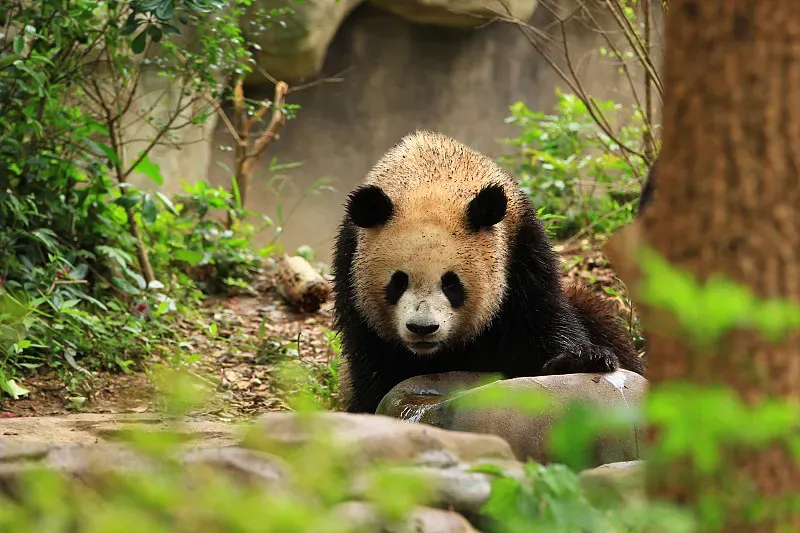
[Image: Hua Hua sitting peacefully in her enclosure, bamboo shoot in paw, with her characteristic calm expression — the image that made millions of people fall in love with her gentle personality]
The Rice Ball Who Stole Everyone’s Heart 🍙
Hua Hua’s fans gave her another nickname: “Fan Tuan” — which means rice ball. The name comes from her unusually round, compact body shape. Where other pandas are long and bear-like, Hua Hua is more… spherical. More huggable. More like a fluffy black-and-white rice ball with legs.
The rice ball comparison caught on because it captured something essential about Hua Hua’s appeal. A rice ball is simple, comforting, and makes you smile. It’s not fancy or complicated. It’s just… good. That’s Hua Hua: simple, comforting, and making millions of people smile just by being herself.
Did You Know? 🧠 Hua Hua’s body shape is partly genetic — she’s naturally smaller than most pandas her age — and partly a result of her calm, low-stress lifestyle. Pandas who experience less stress tend to carry a bit more weight, and Hua Hua is about as low-stress as a panda can be! Her relaxed approach to life shows in her round, peaceful appearance.
Why Hua Hua Matters
At this point, you might be wondering: “She’s just a calm, round panda. Why does everyone care so much?”
The answer says more about us humans than it does about Hua Hua.
The world can be fast, loud, and competitive. We’re told to run faster, work harder, achieve more. Rest is sometimes seen as laziness. Gentleness is sometimes mistaken for weakness.
Hua Hua does none of these things. She moves at her own speed. She accepts what comes her way without fighting. When she loses the best bamboo, she finds the bamboo that’s left and eats it with the same calm expression. She doesn’t compete. She doesn’t rush. She doesn’t worry about what she’s missing.
And look what happened: millions of people loved her exactly for being this way.
The lesson Hua Hua teaches us is simple but powerful: you don’t have to be the fastest to be beloved. You don’t have to be the strongest to be valued. You don’t have to push and fight and compete to be seen. Sometimes the best thing you can be is exactly who you are — calm, patient, and moving at your own perfect pace.
This is the same message we explore in our article on the Fu Bao effect and why pandas heal human anxiety — pandas, especially gentle ones like Hua Hua, have a remarkable ability to calm the human mind simply by being themselves.
Hua Hua’s Daily Life
What does a day look like for the world’s most famous gentle panda?
Morning (7:00 AM): Wake up slowly. Stretch. Blink. Consider getting up. Stretch again. Finally stand and waddle to the fresh bamboo.
Late Morning (10:00 AM): Eat bamboo at a relaxed pace. Watch other pandas rush around. Take a nap in a sunbeam.
Afternoon (2:00 PM): Wake up from nap. Eat more bamboo. Roll over onto back, paws in the air. Look very round and peaceful. Take another nap.
Evening (5:00 PM): Final bamboo session. The keepers call “Guo Lai!” Hua Hua comes. Slowly. Eventually. She eats her dinner and settles in for a long, peaceful night.
That’s it. That’s her whole day. And millions of people find it absolutely perfect.
Frequently Asked Questions
Where can I see Hua Hua?
Hua Hua lives at the Chengdu Research Base of Giant Panda Breeding in Sichuan, China. You can see her in the nursery area. But be prepared — she’s so popular that viewing lines can be long! Many fans also watch her on the base’s live “panda cam” online.
Does Hua Hua have any babies?
Hua Hua was only born in 2020, so she is still young in panda terms. Pandas don’t usually have cubs until they’re 5-7 years old. She may become a mother in the future, and fans are already excited about what gentle, patient baby pandas she might raise!
What does her name “He Hua” mean?
“He” (和) means harmony or peace. “Hua” (花) means flower. Together, “He Hua” means “harmonious flower” or “flower of peace.” Looking at her gentle personality, it’s hard to imagine a more perfect name. Panda names always carry deep meaning — learn more about the tradition of panda naming culture!
What can you learn from Hua Hua today? The next time you feel rushed, or like you’re falling behind, or like everyone else is faster than you — remember Hua Hua, the round, slow, rice-ball panda who became one of the most beloved animals in the world simply by being herself. Going at your own pace is not falling behind. It’s marching to your own gentle, bamboo-eating rhythm. And millions of people think that’s beautiful. 🌸🐼
Pandacommon Editorial Team
Pandacommon is a global knowledge project documenting giant pandas, habitats, and conservation history. We combine verified data with engaging storytelling to build a deeper archive of the panda world.
Learn more about our mission →Tags in this article
Questions readers often ask
Why is Hua Hua so famous?
Hua Hua became famous because of her gentle, patient personality — she is smaller and slower than other pandas, and often gets her bamboo taken by faster pandas. Instead of fighting back, she calmly waits or finds another source. This peaceful nature touched millions of people, especially during difficult times. She represents the idea that you don't have to be the fastest or strongest to be loved.
What does 'Guo Lai' mean?
'Guo Lai' (果赖) means 'come here' in Sichuan dialect. It's what Hua Hua's keeper calls her when it's feeding time, and the phrase went viral on Chinese social media. Fans now use 'Guo Lai' as an affectionate nickname for Hua Hua.
Is Hua Hua smaller than other pandas?
Yes, Hua Hua is noticeably smaller and more compact than pandas her age. She has a rounder, more 'rice ball' shaped body that fans find especially cute. Her smaller size, combined with her gentle personality, has made her one of the most photographed and most beloved pandas at the Chengdu Research Base.