Pe Pe
佩佩
51 years old
chapultepec_zoo
Pe Pe is a male giant panda born on 1 January 1975 in the wild of Sichuan Province, China. His studbook number is 211, a...
View profile
Panda archive
欣欣
Xin Xin (欣欣, "Hope", studbook #360) is a female giant panda born July 1, 1990 at Chapultepec Zoo in Mexico City. She is the daughter of Tohui (the first panda born outside China to survive) and Chia Chia from London Zoo. She is the only giant panda in the world not owned by China — a permanent legacy of the 1975 gifting agreement between China and Mexico. As of July 2026 she is 36 years old, one of the longest-living pandas globally, and the last panda in Latin America.
How to use this page
This page brings together the core facts, timeline, family graph, media, place journey, and related reading for Xin Xin.
Profile snapshot
Birth date
July 1, 1990
Birth place
Chapultepec Zoo
Current location
Chapultepec Zoo
Status
Alive
Studbook
#360Archive activity
3 updates · 33 media
Narrative
Start with a concise summary, then continue into the full narrative record for Xin Xin.
Short version
Xin Xin (欣欣, "Hope", studbook #360) is a female giant panda born July 1, 1990 at Chapultepec Zoo in Mexico City. She is the daughter of Tohui (the first panda born outside China to survive) and Chia Chia from London Zoo. She is the only giant panda in the world not owned by China — a permanent legacy of the 1975 gifting agreement between China and Mexico. As of July 2026 she is 36 years old, one of the longest-living pandas globally, and the last panda in Latin America.
Xin Xin (Chinese: 欣欣, “Hope”, studbook number 360) is a female giant panda born on July 1, 1990 at Chapultepec Zoo (Centro de Conservación de la Vida Silvestre de Chapultepec) in Mexico City, Mexico. She was conceived naturally.
Her mother is Tohui (朵蔚, studbook 251, July 21, 1981 – November 16, 1993), the first giant panda ever born in captivity outside China to survive to adulthood, a beloved Mexican cultural icon and subject of the hit song “Osito Panda.” Her father is Chia Chia (佳佳, studbook 213), a male giant panda from London Zoo sent to Mexico in the late 1980s for international breeding. Xin Xin is the granddaughter of Ying Ying (迎迎) and Pe Pe (贝贝), the pair of giant pandas gifted by China to Mexico on September 10, 1975 — the first pandas to live in Latin America.
Xin Xin holds an extraordinary legal distinction: she is the only giant panda in the world whose ownership is permanently vested in a country other than China. She is legally the property of the Mexico City government / Chapultepec Zoo. China has no claim over her and has never requested her return.
In 1975, following the establishment of China-Mexico diplomatic relations, China donated (无偿赠送) two giant pandas — Ying Ying (迎迎) and Pe Pe (贝贝) — to Mexico as national gifts. The diplomatic agreement specified:
This 1975 agreement represents a policy watershed: it belongs to the era when China gifted pandas as diplomatic presents, a practice that ended completely by 1984.
In 1984, China fundamentally changed its panda policy:
Although Xin Xin was born in 1990 — after the 1984 shift — she is a descendant of the 1975 gift pandas and therefore falls under the old gifting agreement. The 1984 policy applies only to pandas obtained after that date. Xin Xin is a historical exception.
Xin Xin’s father is Chia Chia (佳佳, studbook 213), a male panda loaned from London Zoo. Her mother is Tohui (朵蔚, studbook 251), a Mexican-owned descendant of the 1975 gift pair. Under the original gifting agreement, ownership follows the maternal line: the father’s loan status does not affect the offspring’s ownership. Since Tohui was Mexico’s property, Xin Xin is also Mexico’s property — regardless of her father’s origin.
Both Mexico and China formally recognize Xin Xin’s unique status:
Xin Xin is the third generation of Mexico’s celebrated panda dynasty, which produced eight cubs at Chapultepec Zoo, five of whom survived to adulthood — making it one of the most successful panda breeding programs outside China.
| Generation | Panda | Studbook | Years | Relation |
|---|---|---|---|---|
| 1st | Ying Ying (迎迎) | 165 | 1975–1989 | Grandmother (gifted from China) |
| 1st | Pe Pe (贝贝) | — | 1975–1988 | Grandfather (gifted from China) |
| 2nd | Tohui (朵蔚) | 251 | 1981–1993 | Mother (first panda born outside China to survive) |
| 2nd | Liang Liang (亮亮) | — | 1983–? | Aunt |
| 2nd | Xiu Hua (秀华) | 291 | 1985–? | Aunt |
| 3rd | Xin Xin (欣欣) | 360 | 1990–present | Last surviving descendant |
| 3rd | Shuang Shuang (双双) | 332 | 1987–2022 | Sister (deceased) |
Xin Xin’s sister Shuang Shuang (双双, studbook 332) lived to 35 and died on July 11, 2022. With her passing, Xin Xin became the sole surviving panda in Latin America.
Xin Xin has lived her entire life at Chapultepec Zoo in Mexico City’s Bosque de Chapultepec. Her enclosure sits at approximately 2,300 meters (7,500 ft) elevation, similar to the pandas’ native habitat in Sichuan, China — a factor attributed by researchers to Mexico’s remarkable success in panda breeding.
Her keeper Elías García has cared for her since 2010. She is known for her strong, dominant personality and her love of apples. She consumes approximately 10 kilograms of bamboo daily along with apples, rice, carrots, and a Mexican specialty — cactus leaves (仙人掌叶).
Through operant conditioning, Xin Xin voluntarily participates in medical checkups, allowing blood draws and physical exams without anesthesia — a testament to the strong bond with her keepers, known affectionately as “los panderos.”
On July 1, 2026, Xin Xin celebrated her 36th birthday at Chapultepec Zoo, an event that drew thousands of visitors from across Mexico and Latin America. The celebration was co-organized by the Mexico City Environment Department, Chapultepec Zoo, the Mexican Chinese Cultural Center, and the Mexican Chinese Cultural Exchange Association.
Activities included:
In her keynote speech, Adriana Fernández, General Director of Chapultepec Zoo, described having Xin Xin as “Mexico’s pride” and noted that her remarkable 36-year lifespan “fully demonstrates the importance of scientific breeding and professional care.”
Ni Cheng, Counselor of the Chinese Embassy in Mexico, remarked that Xin Xin “has witnessed the development of China-Mexico friendship and is a symbol of the friendship between the two peoples.”
Xin Xin is now in the final stage of her life. Mexico City’s Environment Department has stated that she is in an advanced geriatric phase, and the zoo is preparing accordingly. Her movement has slowed noticeably, and she often stays in her indoor enclosure. Despite this, the zoo provides meticulous daily care, selecting approximately 10 kilograms of fresh bamboo each day, supplemented by apples, rice, carrots, and cactus leaves.
Xin Xin represents the final chapter of Mexico’s panda dynasty that began in 1975. She is one of the oldest living giant pandas under professional care worldwide, having far exceeded the species’ typical life expectancy of 20–25 years. At 36, her age is roughly equivalent to 110 human years.
As the last surviving descendant of the 1975 gifting era, she will likely be the final panda owned entirely by a country other than China — a living bridge between the era of panda gifts and the modern era of conservation loans.
When Xin Xin passes, it will mark the end of pandas in Latin America unless Mexico negotiates a new loan agreement with China. Chapultepec Zoo has preserved cryogenically frozen genetic material from Xin Xin’s relatives, ensuring that Mexico’s contribution to giant panda conservation can continue.
The Bank of Mexico minted commemorative coins for her mother Tohui’s fifth birthday, and the Mexican government issued 2.4 million lottery tickets for Xin Xin’s 35th birthday — reflecting the extraordinary place these pandas hold in Mexican culture and national identity.
Evidence
Key updates and milestone events tied to Xin Xin.
Knowledge graph
See the core family graph first, then continue through related pandas and archive themes.
Gallery
Images and video connected to Xin Xin.
Connected archive
This is the next layer around the profile: place journey, current geography, reading context, and nearby panda records.
Chapultepec Zoo
Mexico City, Mexico
Xin Xin is currently linked to Chapultepec Zoo.
culture
The giant panda diaspora spans 58 locations across continents — from the misty bamboo forests of Sichuan to climate-controlled enclosures in Singapore, from mountain reserves that shelter free-ranging pandas to urban zoos that host celebrities. This article provides the definitive guide to panda geography: where they live, why they're there, what the distribution reveals about conservation history, and how the map has changed from 1869 to today.
nature
A panda's molars crush bamboo for 12-16 hours daily, accumulating decades of abrasive wear from silica-rich plant fiber. By age 20, the enamel may be gone entirely. This article examines panda dental anatomy, the pathology of tooth wear, the veterinary dentistry that repairs broken teeth, and why dental health is the single greatest determinant of panda lifespan in the wild.
nature
A female giant panda is fertile for just 24-72 hours per year — the narrowest reproductive window of any large mammal. This article explores the intricate biology of panda reproduction: the hormonal cascade that triggers estrus, the phenomenon of embryonic diapause (delayed implantation), the challenges of artificial insemination, and why captive breeding was so difficult for so long.
nature
Every captive giant panda on Earth has a unique studbook number that maps directly to its parents, grandparents, offspring, and location history. This guide teaches you how to use the PandaCommon database to trace any panda's lineage — from Fu Bao back to Pan Pan in three generations — and explains what the studbook numbers reveal about genetic relationships, breeding history, and the hidden family connections that link pandas across continents.
Browse nearby, regional, and fast-moving panda profiles related to this archive entry.
佩佩
Pe Pe is a male giant panda born on 1 January 1975 in the wild of Sichuan Province, China. His studbook number is 211, a...
View profile双双
Shuan Shuan (双双, "Double") was a female giant panda born at Mexico City's Chapultepec Zoo in 1987. The seventh and last ...
View profile双双
Shuang Shuang (双双, studbook #332) was a female giant panda born June 15, 1987 at Mexico City's Chapultepec Zoo — the sec...
View profile佩佩
Pe Pe is a male giant panda born on 1 January 1975 in the wild of Sichuan Province, China. His studbook number is 211, a...
View profile双双
Shuan Shuan (双双, "Double") was a female giant panda born at Mexico City's Chapultepec Zoo in 1987. The seventh and last ...
View profile双双
Shuang Shuang (双双, studbook #332) was a female giant panda born June 15, 1987 at Mexico City's Chapultepec Zoo — the sec...
View profile冰星
Bing Xing is a male giant panda born on September 1, 2000 at Chengdu Research Base. He lived at Hangzhou Wildlife Park (...
View profile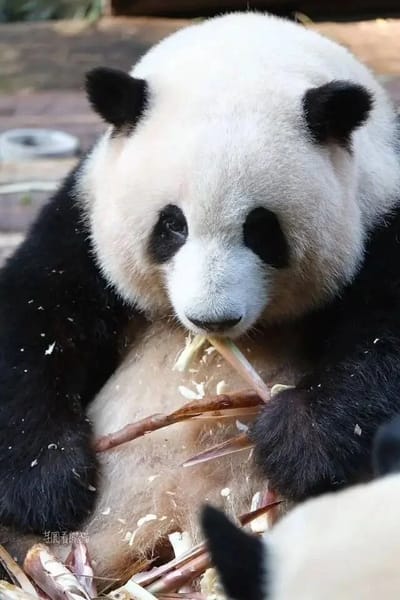
成和花
Cheng Hehua (Hua Hua, 花花), nicknamed "Fruit Lai" (果赖) because she responds to this Sichuan dialect call, is China's top...
Trust
Information on this page is compiled from conservation institutions, official panda records, media archives, and the wider PandaCommon research workflow.
No external reference links are attached yet.
Move from this profile into more pandas, place histories, and the wider library.
Explore over 762 panda profiles, place links, and archive journeys.