Table of contents (10 sections)
Feeding Pandas Across Europe: The Transnational Bamboo Supply Chain
Key Fact: Every panda in Europe — from Berlin to Madrid, from Edinburgh to Beauval — eats 12-38 kilograms of fresh bamboo daily, none of which grows naturally in European forests. Supplying this demand requires a sophisticated logistics network: dedicated bamboo plantations in southern France and the Iberian Peninsula, weekly refrigerated truck deliveries crossing national borders, frozen emergency stockpiles, and a mutual-aid network among zoos that activates when supply chains fail. The European panda bamboo supply chain is a hidden infrastructure that costs each zoo hundreds of thousands of euros annually — and it is the single largest operational challenge of keeping pandas outside Asia.
Key Takeaways
-
The bamboo supply chain is the hidden backbone of every overseas panda program — more logistically demanding than veterinary care, more expensive than enclosure maintenance, and operating year-round without interruption.
-
Zoos have built a mutual-aid emergency network. When frost destroys a plantation or transport is delayed, European zoos share bamboo reserves across borders — an informal but reliable system that has never failed to keep pandas fed.
-
The European bamboo model offers lessons for a warming world. As climate change threatens wild bamboo forests in China, the techniques developed for European panda feeding — plantation cultivation, species diversification, cold-chain logistics — may become relevant for in-situ conservation.
The Daily Bamboo Problem
At 5:00 AM in the Loire Valley of central France, a team of workers moves through a 20-hectare bamboo plantation. They carry machetes and wear gloves — bamboo leaves have sharp edges. They cut mature stalks of Phyllostachys aurea and Pseudosasa japonica, bundle them into 30-kilogram bales, and load them onto a refrigerated truck. By 8:00 AM, the truck is on the autoroute, heading north. By 2:00 PM, it arrives at ZooParc de Beauval, where Yuan Meng and Huan Huan — the zoo’s giant pandas — are waiting for lunch.
This is the daily rhythm of the European panda bamboo supply chain. The scale is relentless: a single adult panda consumes 12-38 kilograms of fresh bamboo per day. For a zoo with two pandas, that is 15-25 tons per year. Multiply across the 15+ pandas in European zoos, and the continent moves approximately 150-200 tons of fresh bamboo annually — just for pandas.
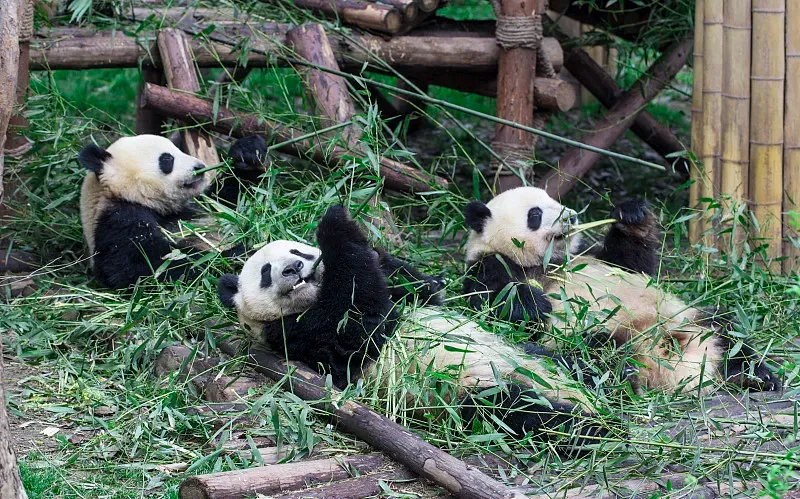
A full-grown panda spends 10-14 hours per day eating. The low digestive efficiency of bamboo — approximately 17-20% — means they must process enormous volumes to extract enough energy. Every stalk that reaches a panda’s mouth in a European zoo has passed through a supply chain involving harvesters, refrigerated transport, quality inspection, and cold storage — a logistics operation that most zoo visitors never see.
Where European Bamboo Comes From
European pandas cannot eat European forest plants — the bamboo species they require are native to Asia and must be deliberately cultivated. European zoos have developed a multi-layered sourcing strategy:
On-Site Plantations
The most self-sufficient zoos grow their own bamboo. ZooParc de Beauval maintains 20 hectares of bamboo plantation — the largest in Europe dedicated specifically to panda feeding. The plantation grows multiple Phyllostachys, Fargesia, and Pseudosasa species, providing the dietary variety that pandas require. Beauval’s harvest is sufficient not only for its own pandas but also produces a surplus that can be sold or donated to other zoos — making Beauval a de facto bamboo hub for continental Europe.
| Zoo | Plantation Size | Self-Sufficiency | Species Grown |
|---|---|---|---|
| Beauval (France) | 20 ha | 100% + surplus | P. aurea, P. japonica, F. murielae, P. nigra |
| Vienna (Austria) | 3 ha | ~60% | P. aurea, F. murielae |
| Madrid (Spain) | 5 ha | ~70% | P. aurea, P. flexuosa, P. nigra |
| Pairi Daiza (Belgium) | 4 ha | ~50% | P. aurea, P. japonica |
Regional Contracting
Zoos without sufficient land or suitable climate contract with commercial bamboo growers — farms in southern France, Spain, and Portugal that have converted agricultural land to bamboo cultivation specifically for the panda market. These farms harvest year-round, with peak production in spring and summer when bamboo growth is most vigorous. The contracts typically specify:
- Species mix: 3-5 species to ensure dietary variety
- Stalk maturity: 1-2 year old stalks (younger = more tender, older = more fiber)
- Harvest interval: Every 3-7 days depending on growth rate and zoo demand
- Delivery schedule: 2-3 times per week by refrigerated truck
Cross-Border Winter Supply
Winter is the bottleneck. Bamboo growth slows dramatically when temperatures drop below 10°C. Northern European zoos (Edinburgh, Berlin, Vienna) face 2-4 months of minimal local growth. Their solution is cross-border supply: trucking bamboo from southern France to Germany, from Spain to the United Kingdom. These winter routes add 1,000-2,000 km per shipment and significantly increase costs.
A typical winter delivery from Seville (Spain) to Edinburgh (UK) covers approximately 2,500 km, crosses three borders, and requires a refrigerated truck operating continuously for 48 hours. The cost: approximately €3,000-5,000 per delivery, depending on fuel prices and border clearance times. Post-Brexit customs procedures added approximately €500 per shipment and 4-6 hours of additional transit time for UK-bound bamboo.
The Economics of Panda Food
Bamboo is the single largest operational cost of keeping pandas abroad. Zoos do not always disclose exact figures, but public records and industry estimates reveal the scale:
| Zoo | Annual Bamboo Cost (est.) | Pandas | Cost per Panda | Source Notes |
|---|---|---|---|---|
| Edinburgh Zoo | £70,000 (€80,000) | 2 (Tian Tian, Yang Guang) | €40,000 | Public FOI disclosure; imported from Netherlands |
| ZooParc de Beauval | €150,000-200,000 | 3-4 (Huan Huan, Yuan Zi + cubs) | €50,000 | Internal operational estimates; includes plantation maintenance |
| Vienna (Schönbrunn) | €60,000-80,000 | 2 (Yang Yang, Yuan Yuan) | €35,000 | Smaller plantation supplements commercial supply |
| Pairi Daiza | €80,000-100,000 | 2 (Hao Hao, Xing Hui) | €45,000 | Combination of on-site and imported |
| Madrid Zoo | €50,000-70,000 | 2 | €30,000 | Warmer climate reduces winter import needs |
| Berlin Zoo | €90,000-120,000 | 2 (Meng Meng, Jiao Qing) | €50,000 | Northern location requires extensive winter imports |
The cost variation reflects three factors: (1) climate — warmer zoos grow more bamboo locally; (2) plantation size — zoos with their own land reduce purchase costs; (3) transport distance — northern zoos pay more for winter deliveries.
To put these numbers in perspective: the annual bamboo cost for a pair of pandas in northern Europe (€80,000-100,000) is equivalent to the salary of 1.5-2 full-time zookeepers. It exceeds the annual cost of veterinary care (typically €30,000-50,000) and enclosure maintenance (€20,000-40,000). Bamboo is not a line item on a zoo’s panda budget — it is the budget.
The Species Question
Pandas in China eat primarily Bashania and Fargesia bamboo species. These species can be grown in Europe but are not the most productive European bamboo cultivars. European zoos have experimented extensively with alternative species:
| Species | Native Range | Grown In Europe | Panda Acceptance | Growth Rate | Cold Hardiness |
|---|---|---|---|---|---|
| Phyllostachys aurea | Southeast China | Widely | Good (primary species) | Fast | Moderate (-15°C) |
| Pseudosasa japonica | Japan, Korea | Widely | Good (secondary species) | Moderate | High (-20°C) |
| Fargesia murielae | Central China | Gardens, zoos | Good (closest to native) | Slow | High (-25°C) |
| Phyllostachys nigra | Central China | Southern Europe | Moderate | Fast | Low (-10°C) |
| Phyllostachys edulis | Southeast China | Limited (southern) | Variable | Very fast | Low (-8°C) |
| Bashania fangiana | Sichuan, China | Experimental only | Preferred (wild species) | Very slow | Moderate |
The key principle is diversity. Pandas in the wild eat 5-7 bamboo species seasonally, and captive pandas show clear preferences between species. A zoo that provides only one bamboo species risks the panda refusing to eat or developing nutritional monotony. Most European zoos maintain 3-5 species in rotation, adjusting the mix based on seasonal availability and individual panda preferences.
Did You Know? During Edinburgh Zoo’s 12-year panda hosting, Tian Tian and Yang Guang consumed approximately 150 tons of bamboo in total — enough to fill a shipping container every 2-3 months. The bamboo was sourced from a specialized grower in the Netherlands and transported weekly by refrigerated truck across the North Sea via ferry. The total bamboo budget over the program’s life exceeded £840,000 (€960,000).
Supply Chain Risks
The European bamboo supply chain is robust but not invulnerable. Multiple risks threaten continuity:
Frost
A late-spring frost can destroy a bamboo plantation’s new shoot crop for the entire growing season. In 2017, an unexpected April frost in the Loire Valley damaged approximately 30% of Beauval’s bamboo plantation, forcing the zoo to activate emergency import arrangements with Spanish growers for 6 weeks while the plantation recovered.
Drought
Bamboo requires substantial water. Southern European plantations (Spain, Portugal) face periodic drought conditions. During the 2022 European drought, some Iberian bamboo growers reported 40-50% reduced yields, requiring zoos to increase imports from alternative sources.
Transport Disruptions
Bamboo is perishable. A 24-hour transport delay can render an entire shipment unusable — wilted bamboo loses palatability and nutritional value. Strikes, border closures, and extreme weather events are the primary disruption risks.
Disease
Bamboo mosaic virus and bamboo blight can affect plantations, though neither has caused a major panda supply disruption in Europe. Zoos maintain biosecurity protocols to prevent disease spread between plantations.
The Emergency Bamboo Network
Perhaps the most remarkable feature of the European panda bamboo system is the informal mutual-aid network among zoos. When one zoo faces a supply disruption — a frost-damaged crop, a delayed shipment, a customs holdup — others in the network share their reserves.
The network operates through trust and reciprocity. Beauval has loaned bamboo to Vienna. Vienna has shared with Berlin. Berlin has supplied Pairi Daiza during a transport strike. There are no formal contracts or payment schedules — just a shared understanding that any zoo could be next, and the priority is keeping pandas fed.
The network was tested during the COVID-19 pandemic (2020-2021), when border closures and flight cancellations disrupted international transport across Europe. Zoos activated their emergency protocols: frozen bamboo reserves were rationed, delivery schedules were consolidated, and the mutual-aid network was coordinated through a shared WhatsApp group of panda keepers and nutritionists. No European panda went hungry.
Global Comparison: Bamboo Supply by Region
| Region | Primary Sourcing | Winter Challenge | Annual Cost Estimate (per panda) | Number of Pandas |
|---|---|---|---|---|
| Europe | Plantations (France, Spain) + imports | Significant (northern zoos) | €35,000-50,000 | ~15 |
| North America | Plantations (California, Georgia, Florida) | Moderate (southern zoos have advantage) | $30,000-50,000 | ~10 (declining) |
| China (domestic zoos) | Local wild bamboo | Minimal (native climate) | ¥50,000-100,000 (€6,500-13,000) | 600+ |
| Southeast Asia (Singapore, Malaysia) | Plantations + China imports | None (tropical) | SGD 300,000-500,000 (€200,000-340,000) | 4 |
| Japan | Local plantations + China imports | Moderate | ¥5-10 million (€35,000-70,000) | ~12 |
The comparison reveals a striking disparity: keeping a panda in Europe costs 3-5 times more in bamboo than keeping one in China — but keeping one in Singapore costs 5-10 times more than Europe. The tropical climate challenge, explored in our article on tropical panda cooling, makes bamboo preservation the dominant cost for Southeast Asian facilities.
What the Future Holds
Two trends will shape the European bamboo supply chain over the next decade:
Climate adaptation. European plantations are experimenting with drought-resistant bamboo cultivars and expanded irrigation infrastructure. Some zoos are investing in indoor bamboo cultivation using hydroponic systems — a technology that could provide year-round supply independent of outdoor climate.
Localization. The post-Brexit customs friction and periodic supply disruptions have accelerated efforts to localize bamboo production. Several European zoos are expanding their on-site plantations, and a cooperative European Bamboo Growers Network has been proposed to coordinate planting, harvesting, and distribution across the continent.
The European bamboo supply chain is a hidden infrastructure that most zoo visitors never think about. But it is one of the most important systems in global panda conservation — a logistics network that keeps pandas fed on a different continent, using plants that do not grow there naturally, maintained by a network of growers, drivers, and keepers who rarely see the pandas their work supports.
Frequently Asked Questions
Can pandas eat frozen bamboo?
Yes, but they prefer fresh. Frozen bamboo is stored at -20°C and retains nutritional value for 6-12 months. Most pandas will eat frozen bamboo when fresh is unavailable, though they may consume slightly less (10-15% reduction). The texture changes after freezing — stalks become softer — but nutritional analysis shows minimal protein or fiber degradation.
Do pandas in warmer European zoos have an advantage?
Yes. Zoos in southern Europe (Madrid, Lisbon) have lower winter bamboo costs because their milder climate allows year-round local growth. They do not need the cross-border winter imports that northern zoos require. The annual bamboo cost for Madrid is approximately 40-50% lower than for Edinburgh.
What happens to excess bamboo?
Nothing is wasted. Unsold or leftover bamboo is composted, used as animal bedding for other species, or fed to other herbivores at the zoo (elephants, rhinos, gorillas often enjoy bamboo as a dietary supplement). Beauval’s plantation surplus supplies not only other panda zoos but also the zoo’s own non-panda herbivores.
Would climate change affect European bamboo plantations?
Differently than in China. European bamboo plantations face increased drought risk in southern Europe but potentially longer growing seasons in northern Europe. The net effect on European panda bamboo supply is uncertain but likely manageable through irrigation investment and cultivar selection — far less severe than the threat climate change poses to wild panda habitats in China.

Dr. Sarah Hartwell
Habitat & Ecology Editor
Conservation biologist specializing in habitat assessment, climate change impacts, GIS-based conservation planning, and bamboo corridor restoration. Reviews all habitat and ecology content.
View full profile →Tags in this article
Questions readers often ask
Where do European zoos get bamboo for their pandas?
Most European panda zoos cultivate their own bamboo plantations or contract with local bamboo growers. ZooParc de Beauval in France maintains 20 hectares of bamboo plantation that supplies not only its own pandas but also other European zoos. Some zoos in colder climates import bamboo from warmer regions — southern France, Spain, or Portugal — particularly in winter when local bamboo growth slows. Bamboo is harvested and delivered fresh, typically 2-3 times per week.
Can European bamboo species substitute for Chinese bamboo?
Partially. European zoos cultivate several bamboo species from the genera Phyllostachys, Fargesia, and Pseudosasa that pandas will accept. These species are not identical to the Bashania and Fargesia species pandas eat in China, but pandas have shown good dietary adaptation to European-grown bamboo. The key is providing multiple species so pandas can select preferred varieties, mimicking the diversity of their wild diet.
How much does it cost to feed a panda in Europe?
Annual bamboo costs for a single European zoo range from approximately €80,000 (Edinburgh, two pandas) to over €200,000 (Beauval, multiple pandas plus plantation maintenance). Bamboo is consistently the single largest operational cost of keeping pandas abroad — exceeding veterinary care, keeper salaries, and enclosure maintenance in most facilities.
What happens if bamboo supplies are disrupted?
Contingency plans include frozen bamboo reserves (typically a 7-14 day supply), emergency sourcing from other zoos through a mutual-aid network, and temporary dietary supplementation with panda cake, fruit, and vegetables. Zoos maintain informal but reliable communication channels with each other for exactly this purpose — if Beauval has a frost, Vienna's bamboo can be rerouted.
Do European pandas eat the same bamboo species as wild pandas?
Not exactly. Wild pandas in China eat primarily Bashania and Fargesia species (Bashania fargesii, Fargesia denudata, Fargesia qinlingensis). European pandas eat a different set of species (Phyllostachys aurea, Pseudosasa japonica, Fargesia murielae) that are more productive in European climates. Nutritional analyses show comparable protein, fiber, and sugar content despite the species differences.
Is winter a problem for European bamboo supply?
Yes — winter is the most challenging period. Bamboo growth slows dramatically when temperatures drop below 10°C, and northern European zoos (Edinburgh, Berlin, Vienna) face 2-4 months of minimal local growth. They compensate through: (1) larger summer stockpiles of frozen bamboo; (2) winter contracts with southern European growers; (3) extended delivery routes from Spain or Portugal, adding 1,000-2,000 km to each shipment.
Can pandas refuse European-grown bamboo?
It happens. Pandas are selective eaters, and individuals show strong preferences for specific bamboo species and even specific harvest locations. When a zoo introduces a new bamboo species, keepers typically mix it with the panda's familiar species for 1-2 weeks, gradually increasing the proportion of the new species. Most pandas accept European-grown bamboo after this transitional period, but some individuals never fully adapt and must be supplied with preferred species at higher cost.